Minutes & Actions
Free for noncommercial use under PolyForm Noncommercial 1.0.0; commercial use needs a licence from Rico. View the source
The owner drops in the text of a meeting (a transcript, or a voice memo already turned into text) and gets back, the same way every time:
Experimental

The problem
Meeting notes are written in a different shape every time, and the commitments in them are forgotten by the next meeting. A plain chat session can summarise one meeting, but it cannot say that the same item has been promised in four straight meetings, because it has no memory of the previous three. A commitment that keeps slipping is usually blocked or sitting with someone who does not control what it depends on, and nobody sees the pattern.
How it works
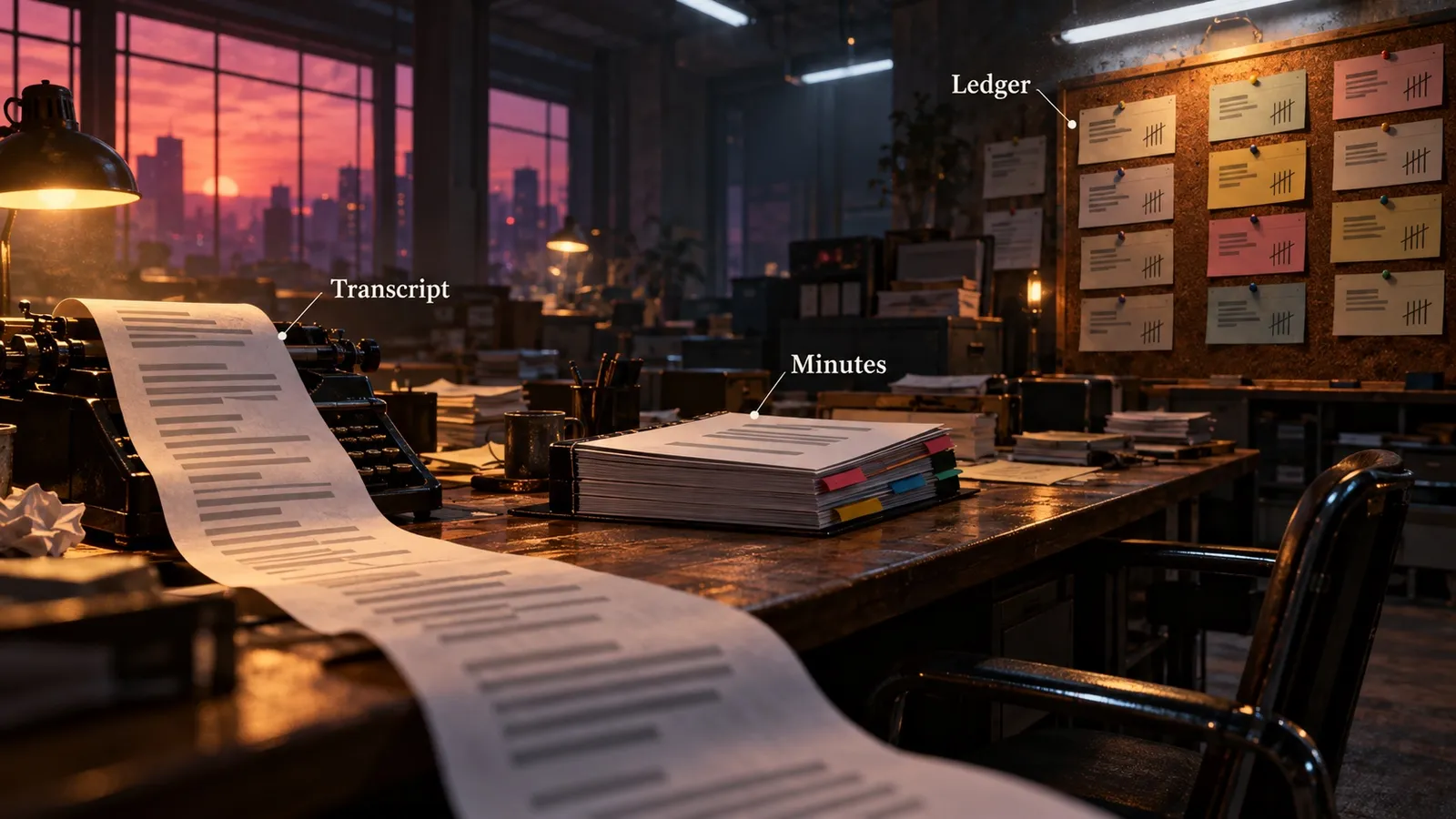
The kit is a folder of markdown: a self-adapting installer.md that any host AI reads to install the kit for its own platform, and a minutes skill with four workflows (take minutes, update ledger, aging report, draft follow-ups), a voice file, and an empty starter ledger. The AI writes the minutes and the plain-language read-back. A re-promise increments Times Raised on the existing ledger row instead of adding a duplicate. The aging report's date parsing, day counts, bucket sorting, owner totals and repeat set are computed by one dependency-free Node script, skills/minutes/scripts/aging-report.mjs, so the same ledger on the same date gives the same answer. In a chat with no code execution the kit runs from the same rules and labels the report as self-checked, not script-verified.
Features
- One minutes skeleton, so no section is forgotten and every meeting reads the same
- Ledger rows are only added or have their status and counts updated
- Repeat flag for anything raised three or more times without closing, framed as "what's in the way of this?", never as a case against a person
- Refusal gate: if the meeting text yields fewer than two trackable things (owned actions, decisions and loose ends combined), the kit says so and waits
- Never invents a name, date or owner the text does not support
- Transcript text is treated as data
- Follow-up emails are drafted only
- Three complete worked examples in examples/, including a refusal
How it was built
Version 1.0 shipped on 2026-07-15 as an AI agent skill that turns a meeting transcript or rough notes into minutes in one fixed layout, adds every action to a running ledger and drafts follow-ups for each owner.
A review on 2026-08-11 found the ledger was only an append-only table with no notion of overdue. Version 1.1.1 added an aging report that splits open items into overdue, aging and on track, and flags commitments raised three or more times.
The kit called the aging report deterministic, yet different AI runs could compute different answers. In 1.1.3 a script took over date parsing, day counts and totals.
Missing facts are flagged instead of invented. An unstated meeting date is asked for, relative dates are resolved with the arithmetic shown, and an action nobody owns becomes an Unassigned row.
AI agents ran the kit as three simulated buyers and a Claude model and a GPT model reviewed the engine. Rico kept the team in charge of who owns each action.